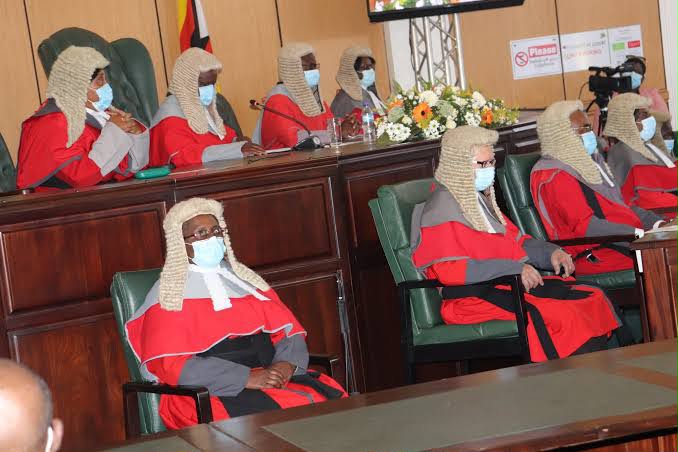
 Today, the Constitutional Court of Zimbabwe decided on two matters.
The first was the case brought by the war veterans, who asked the Constitutional Court to determine whether the President had breached his duty to uphold the Constitution by sitting in a Cabinet meeting that initiated and facilitated Constitutional Amendment Bill No. 3 when he stands to benefit personally from the extension as the incumbent.
The Constitutional Court ruled that it would not entertain the application because the duties of the President that the applicants deemed to have been infringed, were too broad and not specific enough for the Court to exercise its exclusive jurisdiction in terms of Section 167.
This was due to the fact that the applicants had come directly to the Constitutional Court without first going through the lower courts, which would have established and articulated such duties more specifically through legislation.
Accordingly, the Court indicated that the duties and alleged infringements need to be ventilated and tested in the lower courts before the matter can be brought before the apex court.
Section 167(3) tasks the Constitutional Court with deciding whether the conduct of the President and Parliament is constitutional. According to Madhuku, who was representing the war veterans, they respect the judgment and will immediately file the same case in the High Court.
Being a legal novice, I am struggling to understand how the Constitutional Court, which is specifically tasked with deciding whether the President or Parliament has upheld the Constitution, failed to make a determination in what appears to be a clear-cut constitutional matter, considering that the Constitution is the primary law in Zimbabwe and articulates the duties of the President, while all other statutes cascade from it.
I do appreciate the fact that presidential duties are defined and specified in a number of separate statutes, such as the Presidential Powers Act, the Defence Act, and the Public Entities Corporate Governance Act. However, that does not negate the fact that all these statutes are derived from, and expand upon, the duties espoused in the Constitution.
Therefore, I struggle to see how laws that are subordinate to the Constitution can provide more specific definitions over and above those already inherent in the Constitution itself.
The second application was that of Prince Dubeko Sibanda, who had taken Parliament to court on the basis that it should not waste time discussing the Bill because, in his view, it is unconstitutional.
Justice Patel articulated that it was still premature for the Court to make a determination on the issue until Parliament had gone through its legislative processes, so as to avoid judicial overreach and maintain the separation of powers.
As a consequence, Prince Dubeko Sibanda has resolved to wait and see whether the House rejects the Bill. Should it fail to do so, he intends to relaunch the same application.
I am left ambivalent by the judgments because, as I stated above, the judgment in the Dubeko case appears legally logical and consistent with the principle of separation of powers. However, what I am struggling to wrap my head around is why the Constitutional Court needs to wait for Parliament to spend weeks deliberating on a Bill before determining whether it is constitutional, and whether Parliament should be expending resources on it in the first place.
Even more perturbing is the war veterans’ case because, as noted above, the Constitution of Zimbabwe is the primary law that determines the duties of the President, while all other statutes derive and elaborate on those duties. As such, one would expect the Constitutional Court to retain the prerogative of determining whether the President has upheld both the Constitution and his constitutional duties.
Both judgments give the impression that the judges of the apex court are buying time by passing their responsibility down to lower courts which, on the face of it, appear to have neither the jurisdiction nor the constitutional mandate that the Chief Justice and her fellow judges possess to determine such questions.
Anyway, let the process unfold.
Written by Rutendo Matinyarare, Chairman of ZASM.