
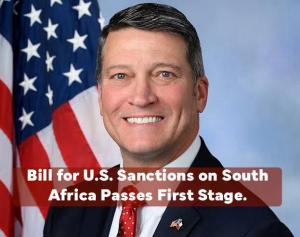
 The bill to review the bilateral relations between South Africa and the United States has passed the first stage after the House Committee approved it.
It now proceeds to the Senate, and once passed there, the US President—alongside the Department of Defense, Department of State, House Foreign Affairs Committee, and US diplomats in South Africa—has 90 days to begin determining whether South Africa or its leaders are a threat to the US government and to identify the actors responsible for this threat.
The President then has 120 days to produce and present a report to the Senate and Congress, stating whether South Africa or its leaders pose a threat to the United States. If he does not identify South Africa or its leaders as threats, he must justify why not. If he does identify South Africa or individuals in the country as posing a threat to US national security interests, the President will be obliged under the National Emergencies Act to declare a national emergency against those South Africans identified as threats.
A declaration of a national emergency against South Africa or its officials would automatically trigger the application of the International Emergency Economic Powers Act (IEEPA). This act allows for the implementation of economic measures—or economic weapons—to block any financial assistance to entities deemed threats or enemies of the United States.
The implications of this act include the blocking or confiscation of assets and finances of designated threats. It may also result in the freezing of bank accounts, blocking of payment clearances and loans, and prohibiting Americans from doing business with those deemed threats to US interests in South Africa.
Once this has occurred, the US President, as enjoined by the Review of US–South Africa Bilateral Relations Act, 2025, must then impose either executive order sanctions or Magnitsky sanctions on the same designated individuals. These sanctions typically prohibit anyone from doing business with the targeted persons—and also extend to anyone who engages in business with them.
Once government officials are designated as threats to US interests, the US government generally tacitly or explicitly prohibits Americans and third-party nations that wish to do business in the US from engaging with that government or entities owned by it. This is because they see the government itself as a vehicle enabling officials to threaten US interests. This is illegal because it exposes innocent citizens to persecution by unilateral sanctions that may deprive them of the enjoyment of their basic human rights. It also is tantamount to extrajudicial punishment of the targeted politicians, without trial, another illegality and human rights violation.
This is what happened with Zimbabwe. If this were to happen to South Africa, then government ministries and parastatals in healthcare, electricity, fuel supply, railways, and other sectors could be denied export payment clearances, loans, material assistance, and the ability to import machinery, technology, or software. These measures could also lead to travel bans on those designated, and prohibit any business between South African or foreign private companies and the South African government or its parastatals. This is how sanctions, initially claimed to target government officials, eventually affect the entire nation and innocent people in particular.
As a recap of how we got here: In 2024, after the South African government took the Israeli government and its officials to both the International Court of Justice (ICJ) and the International Criminal Court (ICC) for genocide in Gaza. Then US Congressman Ronny Jackson introduced a bill titled the US–South Africa Bilateral Relations Review Act. According to his rationale, Jackson claimed that South Africa posed a threat to US security interests because the ANC-led government had not adhered to its stated policy of non-alignment. He cited South Africa’s diplomatic relations with so-called bad actors like Russia, China, Hamas and Iran.
Jackson took issue with the South African government allegedly siding with Hamas after their attacks on Israel on October 7, 2023, by condoning the attacks and then taking Israel to the ICC and ICJ on genocide charges when Israel retaliated. He also raised concerns about South Africa allegedly loading weapons onto a Russian ship, Lady R, to assist in the war against Ukraine, and he condemned Minister Naledi Pandor’s visit to Iran. Additionally, he referenced issues of corruption and state capture.
For these reasons, Jackson’s Act urges the US President to conduct a thorough investigation to determine whether South African officials have engaged in activities that threaten US interests. If so, he calls on the President to impose sanctions on those officials, hence we now have the draft bill having passed the first stage.
Sadly, the crisis for South Africa does not end here. Just three weeks ago, another US representative, Mr Steube, introduced a new bill titled the Addressing Hostile and Antisemitic Conduct by the Republic of South Africa Act of 2025.
This act also seeks to impose sanctions on South African officials for alleged antisemitism, due to South Africa’s decision to take Israel and its leaders to the ICJ and ICC for genocide. Already, some Americans are attempting to sue the South African government for $400 million, alleging that it had prior knowledge of the Hamas attacks on Israel before they occurred.
The intent here appears to be to overwhelm the South African government with legal challenges to force it to withdraw its case against Israel.