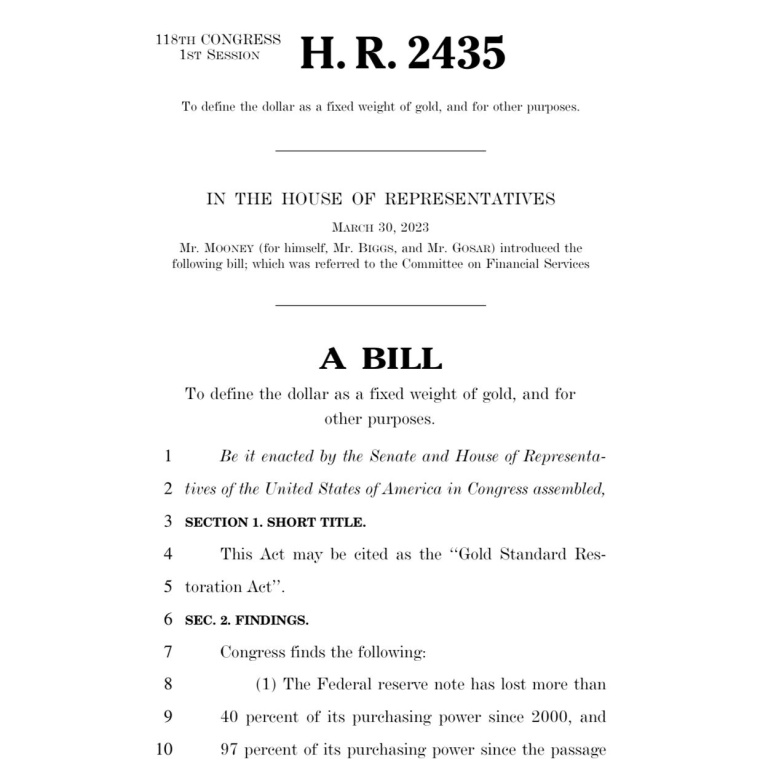

 This week has been an exciting one for Zimbabwe, as the U.S. Congress introduced a bill proposing the repeal of the Zimbabwe Democracy and Economic Recovery Act of 2001 (ZDERA).
Optimism surged after Congressman Brian Jeffery Mast tabled H.R. 5800, known as the “Department of State Policy Provisions Act of 2025.” The bill outlines several proposed changes to U.S. State Department policies, including a realignment of America’s approach to African nations such as Zimbabwe.
Significantly, the bill calls for the repeal of ZDERA—the very law Congress used to pressure President George W. Bush into imposing executive order sanctions on Zimbabwe back in 2003.
Amidst the excitement, many analysts have weighed in on what this development means for Zimbabwe and its future. Some have even described the repeal as the “final nail in the coffin” of sanctions, since ending ZDERA would effectively remove the last remaining coercive economic measures (sanctions) against the country—apart from the Magnitsky sanctions that still target eight individuals and three companies.
ZDERA Is Not A Sanction.
This assessment is inaccurate, because ZDERA itself was never a sanction on Zimbabwe. Rather, it was the legal instrument [legislation] through which the U.S. Congress asked the U.S. President to institute executive order sanctions on Zimbabwe in 2003.
In actual fact, sanctions on Zimbabwe and its population were effectively revoked on March 4, 2024, after the U.S. President ended the government’s state of emergency on Zimbabwe and, with effect, removed Executive Orders E013469, E013391, and E013288. Soon thereafter, the U.S. government also revoked the Code of Federal Regulations (CFR 541) and the International Emergency Economic Powers Act (IEEPA), which had been used to codify and legislatively bring the sanctions into effect in line with U.S. law.
With the removal of these executive orders, the ending of the International Emergency Economic Powers Act measures, and the revocation of the national emergency in line with the National Emergency Act, Zimbabwe as a nation is no longer under U.S. sanctions. In principle, the ZDERA Act has been fulfilled and, in all intents and purposes, has expired.
This means that Zimbabwean government institutions, municipalities, parastatals, private companies, banks, and financial institutions can now engage in business, receive investment, receive assistance, and obtain loans from Americans, their allies and citizens of other countries without the threat of assets being confiscated, payments being blocked, secondary sanctions being levied or criminal prosecution as was the case under the measures.
ZDERA Is Being Repealed Unconditionally.
Another misconception is many commentators have misinterpreted Sections 303(a) and 303(b) of H.R. 5800, reading them jointly to mean that Section 303(b) enjoins Zimbabwe to pay white farmers their $3.5 billion compensation for improvements on their farms, for ZDERA to be repealed.
They have erroneously conflated the unconditional repeal of ZDERA in Section 303(a) with the provisions of Section 303(b), which relate only to Zimbabwe accessing “further funding” or debt cancelation from multilateral lending institutions such as the IMF, World Bank, and Paris Club even before clearing outstanding arrears. These terms for Zimbabwe to access multilateral loans, by letter and intent, are not a suspensive condition for the repeal of ZDERA, but rather a separate issue regarding financial reintegration into western aligned multilateral lending institutions before Zimbabwe has cleared its outstanding arrears.
An argument can also be advanced that ZDERA itself was null and void 𝘢𝘣 𝘪𝘯𝘪𝘵𝘪𝘰, because unilateral sanctions, extraterritorial imposition of law, and extra-judicial punishment [which sanctions requested by ZDERA perpetuated] are illegal under international law.
Many commentators also erroneously believe that ZDERA itself constituted sanctions, since they perceive it as directing U.S. representatives sitting in multilateral institutions, not to support Zimbabwe’s requests for loans or applications for debt cancellation, after the land donor conference held in Harare in 1998, did not halt land reform, and Zimbabwe’s entry into the Congo war.
This too is a misreading, because, as a matter of fact, multilateral lending institutions and their major Western shareholders had already begun denying Zimbabwe loans as far back as September 1999 when the International Development Association blocked its preapproved Economic Structural Adjustment Program (ESAP) loans in September 1999. This was followed by the IMF in October 1999, and the World Bank in 2000, who also denied Zimbabwe preapproved loans and technical support, on the grounds that Zimbabwe had breached the terms and conditions of ESAP by deploying soldiers into Congo using loans provided by these Western institutions.
In essence, the denial of loans articulated in Section 4 of the ZDERA Act S.494 was simply a rationale offered by Congress as it prepared to request that the U.S. President institute executive order sanctions on Zimbabwe. This is clear because the denial of loans is already outlined in Section 3, under the title “FINDINGS,” where Congress details how loans were denied to Zimbabwe as part of a policy adopted by the shareholders of multilateral lending institutions after Zimbabwe allegedly breached ESAP—two years before ZDERA was even enacted.
The aim of Congress here was to paint a picture for the U.S. President that Zimbabwe was a country that does not honor agreements, thereby preparing the ground to ask him to impose executive order sanctions on the leaders of this “irresponsible nation” in Section 6 of ZDERA. Therefore, ZDERA cannot reasonably be read as the trigger for Zimbabwe being denied multilateral loans, since those denials had already taken place well before the Act was tabled for debate.
This means that, with respect to the denial of multilateral loans to Zimbabwe, ZDERA merely noted and codified a pre-existing policy of the shareholders of multilateral lenders. It reinforced the directive to withhold votes in favor of Zimbabwe receiving loans or debt cancellation—something the U.S. and other shareholders were already implementing in multilateral financial institutions prior to ZDERA. Thus, the Act did not itself create sanctions to deny Zimbabwe loans, but instead it articulates Congress’s policy preference to maintain the U.S. government’s pre-existing approach of denying Zimbabwe multilateral loans or debt restructuring from institutions under its influence, until reforms outlined in ZDERA were carried out.
In fact, ZDERA can be read as offering a “carrot-and-stick” approach. It encouraged Zimbabwe to implement reforms such as freedom of the press, freedom of opposition, compensation for white farmers, and compliance with SADC Tribunal rulings on fast-track land reform, if it wished to regain access to loans from the Paris Club and Western-aligned multilateral institutions—after already being in arrears for over two years.
The new H.R. 5800 bill essentially mirrors this approach, offering Zimbabwe similar loan incentives in exchange for reforms long demanded by the U.S. government since 2001. However, these provisions in Section 303(b) have nothing to do with the repeal of ZDERA itself, which, according to Section 303(a), will be done unconditionally.
Zimbabwe Must Avoid Western Multilateral Loans.
Suffice to say, by now, any African country seeking to develop, knows that loans from Western lending institutions often result in the nation surrendering its sovereignty and losing the ability to formulate its own developmental fiscal and monetary policy independently. As such, it is only prudent for the Zimbabwean government to avoid borrowing from these imperialist institutions and instead focus on clearing arrears while seeking financing from BRICS and Chinese institutions, to break the U.S. controlled unipolar monetary system.
Nevertheless, if the government absolutely had to borrow from these Western institutions, now that sanctions are gone, it could lobby other member states—which collectively hold over 50% of the voting rights within these institutions—to vote in favor of Zimbabwe receiving loans or debt cancellation. This would effectively take advantage of the growing U.S. isolation, nullifying the anti-Zimbabwean U.S. vote or its absence.
Many have linked these sanctions by multilateral institutions, which came before Zimbabwe defaulted on loan payments, to the West’s desire to advantage the opposition Movement for Democratic Change (MDC). The reason being, MDC was formed just two months after the International Development Association denied Zimbabwe its first loan in September 1999. This was followed by the IMF’s denial in October of the same year and the World Bank’s in February 2000—just days before the constitutional referendum and two months before the parliamentary elections.
Why Sanctions On Zimbabwe Have Been Removed.
It is also important to understand why executive order sanctions were removed from Zimbabwe by the U.S. President in March 2024. The U.S. President acted after Congress’s Foreign Affairs Subcommittee on Human Rights, Health and Organization, under pressure from the Zimbabwe Anti-Sanctions Movement (ZASM), conducted a human rights impact assessment of its sanctions on Zimbabwe.
This assessment concluded that U.S. executive sanctions [that Congress had requested in ZDERA] were harming civilians, depriving women and children of healthcare and basic rights. Consequently, Congress—in a report pertaining to the human rights impact assessment—urged the U.S. President to lift them. In doing so, Congress tacitly acknowledged that the executive order sanctions they had asked for in ZDERA were harming civilians, rendering ZDERA redundant, if not null and void.
From both a legal and moral standpoint, ZDERA no longer serves a purpose. Legally, executive order sanctions require a national emergency to be declared by the U.S. President. Under the National Emergency Act, once the President has instituted an emergency in response to a threat to the U.S., he must review it every year and provide Congress with reasons for extending or cancelling that national emergency.
Congress, in turn, may accept or reject the President’s decision by voting against it and reversing it.
As a consequence, when Congress asked Joe Biden to remove the executive order sanctions on Zimbabwe in 2022, through their report, there was no longer legislative house support for the President to renew the national emergency on Zimbabwe or to extend executive order sanctions to sustain ZDERA.
Morally, Congress had admitted through its own human rights impact assessment report that the executive order sanctions they requested in ZDERA were harming civilians in Zimbabwe. As such, the sanctions had become contrary to the principles and values of Congress’s Foreign Affairs Subcommittee on Human Rights, Health and Organization, and therefore had to go.
According to Congress’s own report, the executive order sanctions requested in ZDERA had become a contravention of human rights law. Therefore, Biden or Trump insisting on maintaining sanctions emanating from ZDERA risk[s]ed having such decisions challenged and overturned by a congressional vote against any further national emergencies on Zimbabwe, in line with the National Emergency Act.
The repeal of ZDERA is thus axiomatic and inevitable, and it will now normalize relations between Zimbabwe and the United State. This will eliminate over-compliance by third parties and will make business entities feel safe to do business with Zimbabwe after years of overcompliance, as companies feared being penalized, prosecuted, or facing secondary sanctions for doing business in Zimbabwe without a license from the Secretary of State.
Consequences Of The Removal Of Sanctions.
Another consequence of the 2024 removal of executive order sanctions is it muted the Zimbabwe Anti Sanctions Movement (ZASM’s) case in the Gauteng High Court, where we sought a declaratory order from that court against South African banks and international banks domiciled in South Africa—and by deduction, any third-party entity in the Republic—from implementing these illegal sanctions. As a consequence of the US President revoking these measures, the United States government prevented South African courts from making case law that would have made it illegal for entities domicile in South Africa to implement illegal sanctions in the jurisdiction.
So, what have been the benefits of the removal of executive order sanctions on Zimbabwe last year? The changes have been immense. The removal of U.S. sanctions was followed by the UK and EU also lifting their sanctions on Zimbabwe. As a result, Zimbabwean goods now enjoy duty-free access to EU markets, while Zimbabwe can also import technology, machinery, parts, and tools from the EU duty-free. With these developments, the economy is projected to grow by 6% in 2025 and as much as 8% in 2026.
This follows the release of all 144 targets or Specially Designated Nationals—previously restricted by Western sanctions. These included our government, municipalities, officials, and parastatals such as ZMDC, MMCZ, and IDC (which controls major manufacturers like Willowvale, Deven, Sable Chemicals, and Zimphos), as well as the Zimbabwe Defense Industries. With executive order sanctions lifted, these parastatals can now trade our minerals, curb transfer pricing and leakages, retool industry, and access loans—as seen with the resurgence of David Whitehead and Edgars’ clothing manufacturer Carousel, which has increased local production by over 57% in the past year.
More critically, our Ministry of Health can now import medical equipment, emergency vehicles, spare parts, and medicines. As government revenue collection improves due to a growing economy, the Ministry is lifting medical staff salaries to fill the over 60% vacancies caused by the government not having money to pay staff competitive salaries. Meanwhile government has began refurbishing health facilities and building new ones, supported by a U.S. $192 million loan by ABSA and Standard Bank, for hospital construction—helping reduce preventable medical and emergency deaths, estimated at 1.3 million over the 24 years of sanctions.
Since the lifting of sanctions last year, Parirenyatwa Group of Hospitals and Mpilo have had their cancer machines repaired by the U.S. companies that originally manufactured them, and long-term maintenance contracts have been signed.
Even more encouraging is that, after losing more than 109 correspondent banking relationships, international banks with various currencies corespondency are now returning. As a result, Zimbabweans can once again receive foreign currency payments and transfers directly into their accounts from anywhere in the world. Today, when Zimbabweans walk into any bureau de change, they can access foreign currency. Zimbabweans are also now able to use their VISA and MasterCard credit cards worldwide.
On the digital front, Zimbabweans who once struggled to access Western services like PayPal, Sage Pastel, and others can now download and use these apps freely using a Zimbabwean IP. We are also seeing new investments and partnerships—from the British, who have invested in coal and gas production, as well as from American and European investors.
Life has changed dramatically for Zimbabweans, as the isolation of the nation has ended with the removal of executive order sanctions—thanks to the remarkable work and smart strategies of organizations like ZASM and others.
We believe that our case, which began to challenge Biden’s request for immunity from South African courts and threatened to set a legal precedent against the implementation of US sanctions, alongside Congress’s report on the impact of U.S. sanctions on human rights and health in Zimbabwe; the UN declaring the sanctions illegal violations of human rights; and the U.S.’ most important diplomatic partner in Africa—South Africa—championing the fight against western sanctions on Zimbabwe while its DIRCO (Department of International Relations and Cooperation) enjoined the U.S. government to prove the bonafides of its sanctions in South African courts; and international lawyers and U.S. pressure groups joining ZASM in fighting the sanctions, was instrumental in pushing the U.S. government to remove its illegal executive order sanctions, which made ZDERA null and void.
https://zimbabweantisanctionsmovement.org/zdera-repealed-but-in-effect-its-now-null-and-voidenuc