
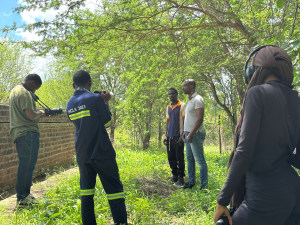
 As we commemorate the Chimoio bombings, I would like to focus on the fraternal grave before me. This is the mass grave of young female trainees—mostly young virgins—who were killed during the Rhodesian government’s mass bombing of Chimoio.
Since its construction, the tomb has been associated with mysterious manifestations. These include cracking, and in 2008, it reportedly oozed thousands of pints of blood for days from the far right-hand corner, where the crack you can see on the bricks in front of us begins.
The blood is said to have flowed for days, forming a large pool on the concrete base of the grave and spreading into the surrounding grass, until a traditional ceremony was performed to stop the bleeding. Many interpreted this as an omen of something terrible about to happen in Zimbabwe. Others believed it was a sign of the nation’s spirits being unhappy with the state of the nation.
At about the same time [in 2008], after national elections in which Morgan Tsvangirai failed to secure 50% plus one, Zimbabwe was plunged into turmoil. Sanctions were strangling the economy; cholera, HIV, and other diseases were taking lives; and violent clashes erupted between opposing political parties. At the same time—after the election and an ensuing by-election—the U.S. and UK deployed warships off the coast of Mozambique, allegedly preparing for an imminent invasion of Zimbabwe.
That invasion was only averted by Kofi Annan and a delegation of Elders, who travelled to Zimbabwe and pressured the ruling party into forming a Government of National Unity with the opposition. This compromise led to the drafting of the 2013 Constitution, which resolved that Zimbabwe—rather than Britain—would compensate white farmers for improvements made on land later redistributed to indigenous people. This constitution was heavily influenced by the UNDP (United Nations Development Program), the EU, and drafters of the South African constitution, negotiated under the figurative barrel of a gun sitting off Mozambique’s coast.
After the bleeding at the tomb ceased, bees reportedly began emerging from the same crack from which the blood had flowed. Those bees have remained there ever since. Bees are also found inside the museum and in the old trees surrounding it. At times they become so agitated that workers (Mozambican citizens or the machinda of the chief) maintaining the memorial cannot operate in the area. Fortunately, on the day we visited, the bees allowed us to pay our respects and document the story of the immense sacrifice made here.
The tomb stands alone [outside the fence] in the western corner of the Chimoio Memorial grounds, commemorating the young innocent girls who were killed just after finishing their training and moments before they were to be deployed to fight in Zimbabwe, then Rhodesia.
About a hundred meters away, inside the enclosure of the Chimoio shrine, lies another mass grave—this one of young boys who had also finished training and were preparing to go to Rhodesia when the bombing struck.
Beside the boys’ burial site is yet another mass grave in which hundreds of trainees and arrivals from Rhodesia, from satellite camps spread across a 16-square-kilometer radius around Chimoio’s main camp are resting. Then, just next to the Museum, under the trees where you also find bees, lies a smaller grave of local Frelimo and Zimbabwean trainers, leaders of the camp and soldiers who were guarding the campa. All the deceased trainees were armed only with fake wooden guns used for training.
So in essence, thousands of unarmed kids were massacred for daring to train to fight for freedom from slavery, oppression, and dispossession. These mass graves symbolize the immense sacrifice of flesh, blood—represented powerfully by the bleeding tomb—innocence, and spirit that was given so that you and I might enjoy liberation, reclaim our land, control our minerals, and pursue our full potential.
Are you honoring the sacrifice of those who died so we could have freedom, peace, and prosperity? Are you using the land, minerals, and education they fought for? They played their part. Now it is your turn to play yours.
I document this history in recognition of the priceless sacrifice made for our freedom between the 23rd and 25th of November, 1977, so that it may never be forgotten. I, Rutendo Matinyarare, also formed the Zimbabweans Unite Against US War Sanctions (ZUAUWS) and Zimbabwe Anti Sanctions Movement (ZASM) to defend what these young comrades fought for and to stop western invasions that intended to give back our land to settles.
I also want this write-up and the documentary I am making about these events, to remind all Zimbabweans that we have an obligation to visit these shrines, pay our respects, and contribute from our earnings—earnings we would never have without the sacrifices made here. Our contributions will help ensure that the shrines are properly maintained and that the local communities sheltered us and protected us during the war, and who continue to preserve these sacred places are fairly rewarded and supported with schools and services.
Written By Rutendo Bereza Matinyarare, Chairman of ZASM.