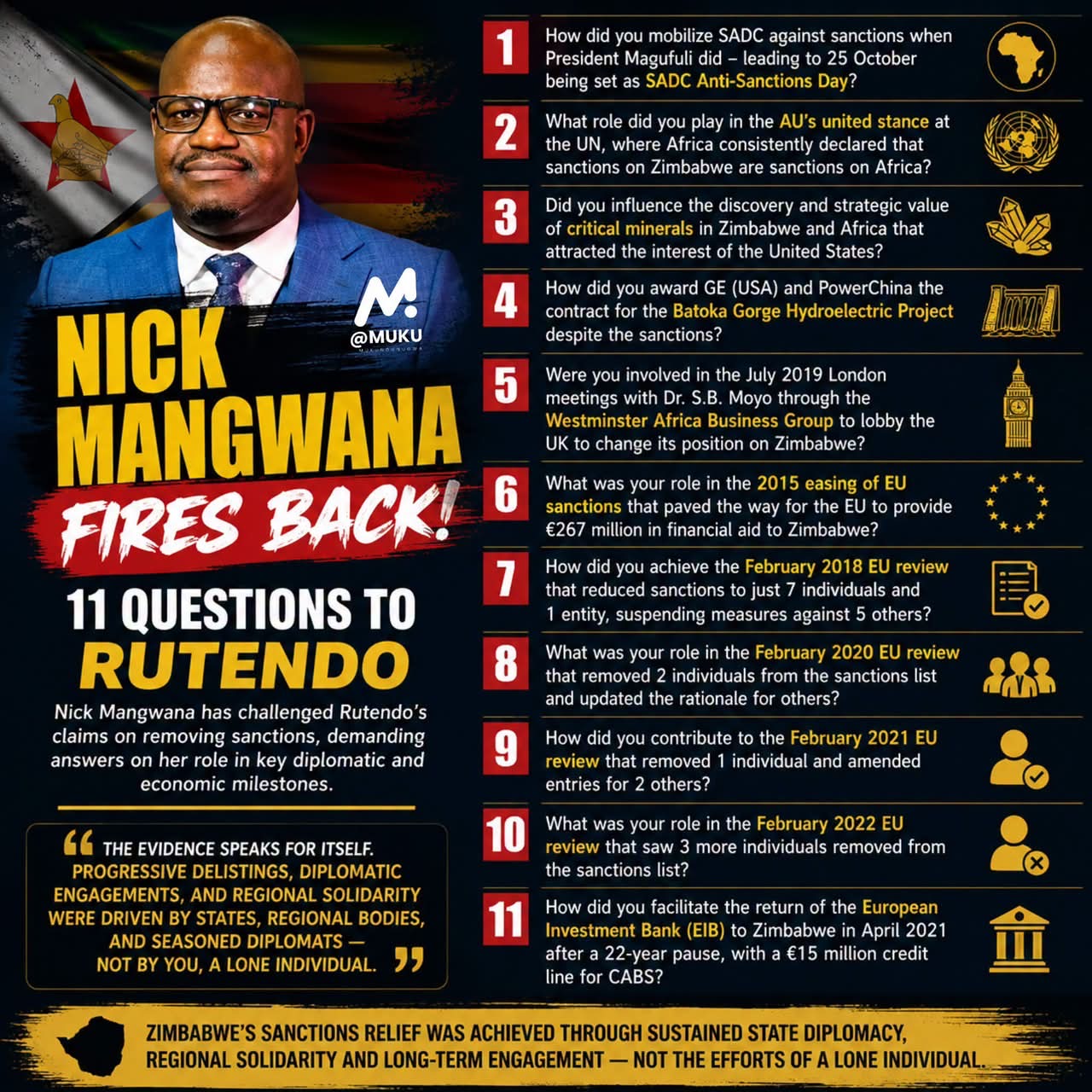
With due respect, PS (permanent secretary), your write-up on sanctions betrays your lack of knowledge of the subject matter, and it’s no wonder why, in 2021, I had to be called to a sanctions debate hosted by SAIIA and Professor Brian Raftopoulos to rescue your brother Paul Mangwana after he ran away from a debate on sanctions where he was being out-debated by Hopewell, Dewa Mavinga and Jacob Mafume because he [your brother] didn’t know the subject matter despite being a lawyer.
Now, if your brother, who is a lawyer for ZANU PF, had no clue on the issue, what are the chances that you know better than him about sanctions? You don’t. Hence, if I ask you to name one sanction and the legal instruments used to implement it, you wouldn’t.
This is why you raise irrelevant arguments about the fight against sanctions because you are clueless about the subject. Hence, people like you failed to fight them for 19 years before I came, and then you envy people like me who mastered sanctions and fought them successfully. For example:
1. Today you want to tell me about the anti-sanctions marches being lobbied for by Magufuli (then SADC Chairman), conveniently forgetting that Magufuli only began to speak about sanctions at the August 2019 SADC meeting, two whole years after I began making videos and writing articles on sanctions that got the CIO to ask me to come to Zimbabwe in January 2019. From there, I left them (Linos Mapfumo) a document that asked them to get Zimbabweans and SADC to march, hence they lobbied SADC for a resolution on marches in the August 2019 meeting Chaired by Magufuli.
2. My videos on Zimbabwean sanctions were already going viral in 2018, and I was the only African with a website dedicated to writing about Zimbabwean sanctions to educate the whole region about sanctions on Zimbabwe.
Till today, if you Google Zimbabwean sanctions, my interviews, social media videos, website, and articles constitute the single biggest body of work on Zimbabwean sanctions in the world.
3. My articles in 2018 defining sanctions on Zimbabwe, like the one below, began to demystify Zimbabwean sanctions and publicize them to SADC and the world, yet there had been no similar articles on the matter before.
4. So, of course Magufuli as Chair of SADC would talk about sanctions on Zimbabwe because he had been lobbied by the Zimbabwean government because of my articles, interviews, strategy and document given to CIO during my visit to DG Moyo. Why was DG Moyo attempting to employ me to fight sanctions if the government was already doing the work? How did DG Moyo know about me to try and recruit me?
5. I even remember complaining to you in August 2019 that SADC and Zimbabwe were using my ZUAUWS logo to advertise the SADC marches because I had an anti-sanctions movement and logo before SADC had one. SADC anti sanctions marches came out of my ZUAUWS campaign and strategy. Why would that be if the anti-sanctions marches began before me?
6. The fact is, I launched an anti-sanctions campaign in 2018, and only after that do we see any other anti-sanctions programs begin in Zimbabwe or SADC. Clear cause and effect.
7. In 2019, I also remember helping you to write a demarche letter to the U.S. government for Sibusiso Moyo after disparaging statements by the U.S. ambassador upon Zimbabwe’s government.
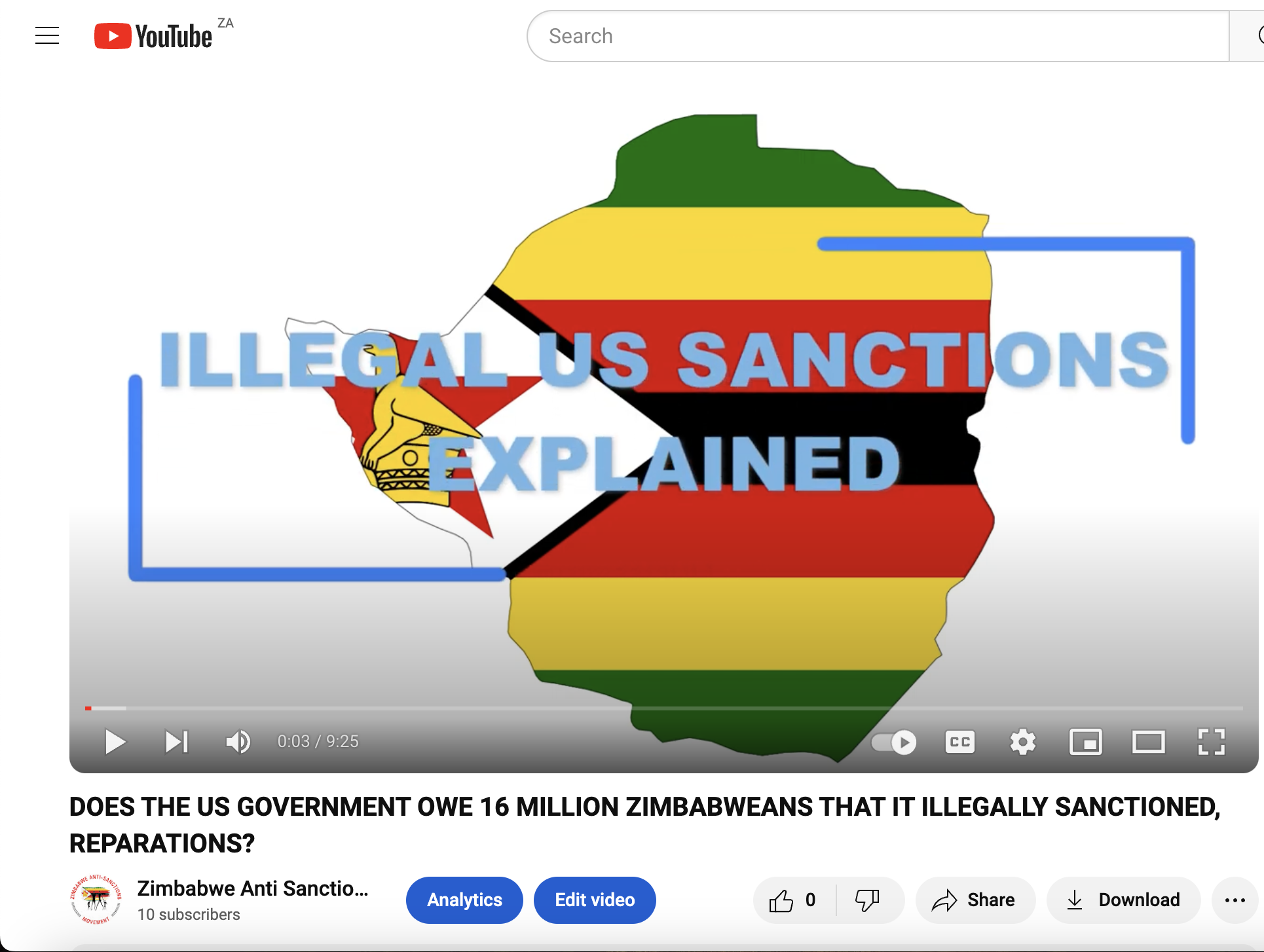
8. On the issue of the UN General Assembly, the United Nations only began to take the issue of Zimbabwean sanctions seriously when they sent the UN Human Rights Council Special Rapporteur to Zimbabwe in 2021.
But what made the UNHRC send a Special Rapporteur to Zimbabwe in 2021 after 19 years of not paying attention to the issue?
It was the very anti-sanctions campaign I started in 2018 that saw me write to the UN Human Rights Council in 2019 asking them to come and do a human rights impact assessment of sanctions in Zimbabwe.
It also came on the backdrop of me personally filing a complaint via their website about human rights violations and the persecution of civilians being perpetrated by their illegal sanctions on Zimbabwe—only individuals and not organisations could lodge this then—and me also getting Ziyambi Ziyambi, the Minister of Justice to officially write, at a government level, asking the UN Human Rights Council to come and measure the negative impact of sanctions on Zimbabwe in order to avert a FATF (Financial Action Task Force) blacklisting. All this you don’t know, PS, because you are not well versed in these issues. You just have a pedestrian understanding of the fight against sanctions but you want to judge from your limited understanding who removed sanctions? Thats like a non-medical student trying to diagnose the cause of cancer.
9. As for strategic mineral resources , that argument betrays. even deeper ineptitude because there are countries with more strategic mineral resources and rare earths required by the U.S. that remain under sanctions. For example, Iran and Venezuela have more oil than almost every other country in the world. China, Russia, Congo, and Afghanistan have more strategic minerals than Zimbabwe, yet they remain under sanctions, and they have people speaking at the UNGA but their sanctions have remained because they did not go to court like us and launch an aggressive anti-sanctions campaign as we did.
Moreover, the U.S. always had access to our resources and markets even under sanctions because they simply gave licences to their companies to do business in Zimbabwe. Hence, Implats, which is predominantly funded by U.S. capital, gets unprocessed platinum out of the country. Additionally, we were too desperate for investment to refuse them access hence Blackrock, Vanguard and Fidelity remained invested in Zim mining companies and other sectors during sanctions.
10. Batoka Gorge is not yet being implemented, so it doesn’t count as a project implemented under sanctions because sanctions are gone and it still has not kicked off. Besides, it came after 2018 when I had already begun my anti-sanctions campaign, which began to see Americans easing their sanctions.
In fact, by 2020, the Americans felt so pressured by the SADC marches that they were contemplating removing sanctions, but they created three reports on money laundering in Zimbabwe—written by Sentry, Africa Risk Consulting and Citizen Maverick—in an attempt to get the FATF (Financial Action Task Force) to push our financial system from the grey list to the black list in order to keep us under financial restrictions.
I am the one who flagged this to Ziyambi and asked him to write to the UN and get them to come and declare sanctions in Zimbabwe illegal and acknowledge that they were closing us out of the legitimate financial system, which was pushing the country to use alternative financial avenues that were then being flagged as money laundering. Before that, none of you had formally measured the negative impact of sanctions.
11. To say the EU removed sanctions in an unspecified period and only left them on seven people, while forgetting that Deutsche Bank cancelled its correspondent banking relationship with Zimbabwe in 2021 and that you failed to get fire engines, grants for the treatment of fruit flies, and other assistance as late as 2023 due to sanctions, betrays your lack of knowledge again.
As late as 2023, Zimbabweans were being denied the right to export ambulances to Zimbabwe from the UK and EU, and they could not access accounting software such as Sage Pastel because of EU sanctions compounded by U.S. restrictions that prohibited anyone from doing business with Zimbabwe without license from the US Treasury.
12. You talk about Grace Mugabe being removed from sanctions in 2021, forgetting that my fight against sanctions and my marches began in 2018 and 2019 respectively. You clearly are not following the correlation between sanctions starting to ease the moment my anti-sanctions strategy began to be rolled out across Southern Africa in 2019.
13. You say that the U.S. removed 49 entities from sanctions in 2014, but you forget that they added another 80, bringing the number of entities to 140, over and above the 87 they had in 2014. However, that didn’t really matter because EO13469 sanctions meant that all government departments, parastatals, and companies were under sanctions.
14. Between 2016 and the removal of sanctions, we had the highest number of correspondent banking cancellations, and in 2019 the South African Reserve Bank notified the RBZ that they would no longer be supplying Zimbabwe with U.S. dollar notes, illustrating that sanctions intensified between 2014 and 2019. Then we began our anti-sanctions campaign, and they started to ease sanctions.
15. Lastly, the ultimate nail in the coffin of sanctions was when Congress sent its legal advisor to contact me on 19 April 2021 and ask how to end our noisy anti-U.S. sanctions campaign we were launching. I told them they needed to conduct a human rights impact assessment of their sanctions on Zimbabwe, and if the sanctions were causing harm, they would need to end them.
On 25 May 2021, the Congress Foreign Affairs Subcommittee on Human Rights, Health, and Organizations began the impact assessment with POLAD. This culminated in a report to Biden that asked him to remove sanctions on Zimbabwe because they were depriving women, children, and civilians of healthcare and their enjoyment of human rights.
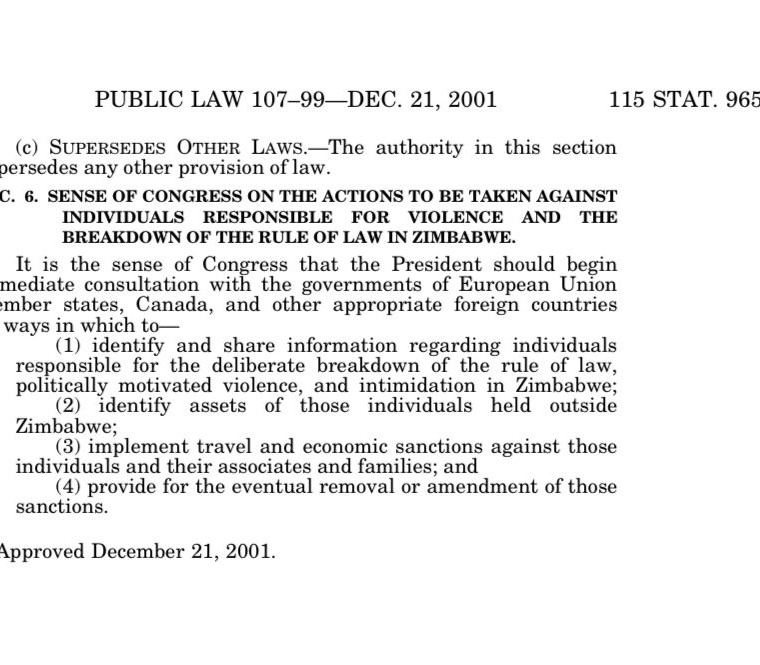
16. So, in other words, it was the same Congress that called for sanctions through ZDERA that later asked for sanctions on Zimbabwe to be removed via a Congress Subcommittee report to Biden. If you believe there was any lobbying more authoritative than Congress itself requesting the removal of its own sanctions, prove it.
However, even more critical is the question: why did Congress reach out to a nobody like me to give them the instruction to conduct the human rights impact assessment?
17. Want me to tighten it further into a 3-line version for a social media post?
You are clearly out of your depth on this issue, PS. Hence, you try to rebut my participation from a point of ignorance and jealousy.
Written by Rutendo Matinyarare, Chairman of ZASM.